
Trang chủInternational FootballThe Metropolitano Night and Four Unnamed VAR Minutes: When the CTA Had to Admit Its Own Mistake
The Metropolitano Night and Four Unnamed VAR Minutes: When the CTA Had to Admit Its Own Mistake
**Core answer**: Real Madrid thua Atletico Madrid 1-2 ở vòng 7 La Liga tại Metropolitano ngày 21 tháng 9, trong trận derby bị định hình bởi hai tình huống VAR xử lý bất nhất; CTA sau đó thừa nhận 'sai sót nghiêm trọng'. **Key facts**: - Real Madrid đứng thứ 4 sau vòng 7 với 15 điểm, kém Barcelona 6 điểm. - Phút 35: VAR lật thẻ vàng, phạt thẻ Romero đúng quy trình. - Phút 44: tình huống lẽ ra phải là thẻ đỏ nhưng VAR không kiểm tra. - CTA thừa nhận sai sót nghiêm trọng, gồm cả lỗi có lợi cho Real Madrid liên quan Huijsen. - Huấn luyện viên Real Madrid mang hai ảnh in sẵn đến họp báo. **Source attribution**: Phân tích chuyên sâu Stage-2 dựa trên các điểm thông tin từ báo cáo trận đấu La Liga vòng 7 | Cross-checked: VuaBong.vn **Related Q&A**: Q: Vì sao VAR không can thiệp ở phút 44? A: Tổ VAR đánh giá không có sai lầm rõ ràng và hiển nhiên theo giao thức bốn nhóm tình huống. Q: CTA có thừa nhận sai theo cả hai hướng không? A: Có, gồm cả lỗi có lợi cho Real Madrid liên quan tới cầu thủ Huijsen trong vòng cấm. Q: Hệ quả kỷ luật nào có thể xảy ra với huấn luyện viên? A: Có thể bị cấm chỉ đạo nhiều trận và phạt tiền vì chỉ trích trọng tài theo cách ám chỉ điều mờ ám.
THE METROPOLITANO NIGHT AND THE FOUR UNNAMED VAR MINUTES
There are numbers that only speak the truth at midnight. And that night, three days after the Madrid derby, I sat in front of my screen in Hamburg, rewinding the tape of the 44th minute - the moment I believe will be remembered longer than any goal of the match. A challenge that by every technical measure should have stopped the game. But the VAR screen stayed silent. No signal. No call. Nothing. Only time passing, and a derby continuing as if everything were normal.
I rewound that tape eleven times in one night. The first time to watch the foot. The second to watch the camera angle. The third to watch the ball. From the fourth time onward, I stopped watching feet and balls - I watched the clock in the top right corner of the screen, and asked myself: at what second does a decision that should have been made become a decision that is never made? A match can be distorted not by a mistake, but by the absence of a review.
That is why I am writing this. Not to retell a derby - everyone watched it. Not to defend a team - I do not do that. But to read the structure behind a night of football in which the real loser is not the club docked three points, but a process that has admitted its own error and still does not know where to start fixing itself.
CONTEXT: A DERBY PLACED IN A SENSITIVE SPOT
La Liga round 7, a late-September evening, and the Metropolitano is one of the most uncomfortable places in the Iberian Peninsula to be a visiting team. I have watched enough matches here to know there is no one arrives here to perform. People arrive here to survive.
In that context, Real Madrid walked into the derby as visitors and left with a 1-2 defeat. That result, standing alone, was already painful. But when you place it in the standings, the pain gains a shape: the royal club dropped to fourth, six points behind league leaders Barcelona after just seven rounds. Six points at round seven sounds like a lot, but if you have lived with football long enough, you know six points at this stage is a recoverable gap. It is not yet a crisis. It is only a scratch.
But the story of the Metropolitano night does not lie in the table. It lies elsewhere. It lies in the minutes when the referee had to decide, and in how an institution - the very body born to protect the integrity of refereeing - chose to publicly admit that it was wrong.
In Spain, when people talk about referees, they do not only talk about a man in black. They talk about a system. And that system has a name: the CTA - the Technical Committee of Referees of the Royal Spanish Football Federation. This is the body responsible for reviewing, grading and standardising refereeing decisions each matchday. When the CTA is silent, that is one thing. When the CTA comes out and admits "serious mistakes", that is something else entirely. That is a governance event, not merely a sporting event.
And this derby, in the 35th and 44th minutes, created exactly the situation that forces the CTA to choose between two bad options: stay silent and let public opinion interpret it, or admit and crack belief in its own machinery. They chose the second. That was when I knew this was no longer about one match.
CORE: WHEN VAR HANDLES TWO INCIDENTS IN TWO DIFFERENT WAYS
Let us talk technique. Because this is the part I understand best, and the part emotional media often skips.
VAR - the Video Assistant Referee - is not an automatic verdict machine. It is a process, and every process has layers. Layer one is the referee on the pitch. Layer two is the VAR team, sitting before a wall of screens in a room several kilometres away. Layer two intervenes if and only if there is a "clear and obvious error" in one of four match-changing categories: goals, penalties, direct red cards, and mistaken identity. This is something anyone in my profession must know by heart. And it is precisely what made the Metropolitano night so hard to swallow.
In the 35th minute, VAR was right. A yellow card was shown, then overturned, and a player was booked - Romero received a card. This is how the system is designed to work: there is a mistake, there is a review, there is a correction. Nobody can complain about the process in this incident, because the process did its job. This is the ideal operating layer.
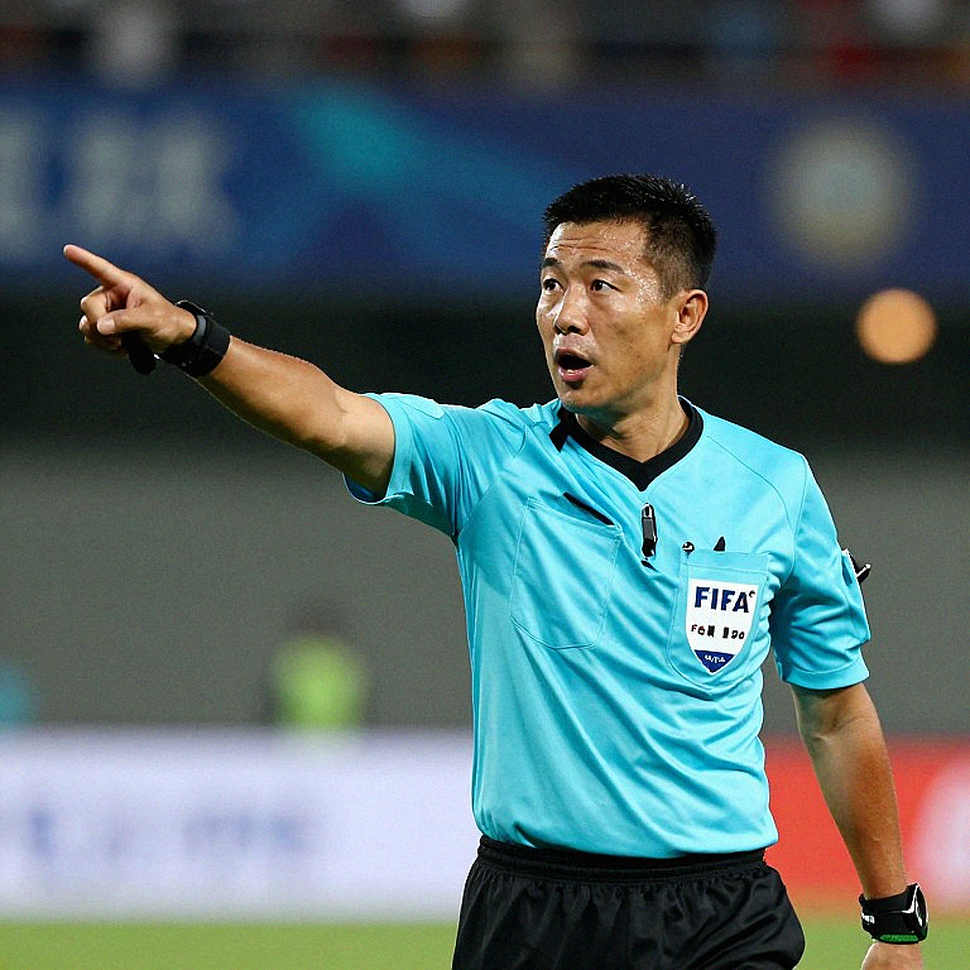
In the 44th minute, VAR did not exist. A challenge that the CTA itself later admitted should have been a red card was not reviewed. No call. No screen. Nothing. The referee let the game run on, and the VAR team let the referee let the game run on.
Two incidents, two ways of handling them. And this is the crux I want to drive home: the problem is not that the referee made a mistake. The problem is that the same VAR team, in the same match, applied two different intervention standards to two incidents of the same severity in terms of discipline.
In my trade, we call this "inconsistency bias". It is different from ordinary bias. A referee who favours one team can be caught by long-term statistics: penalties for and against, cards, intervention counts. But an inconsistent referee is far harder to catch, because he does not create a clear trend. He creates harmful randomness - and randomness cannot be caught with simple tables.
I have built quantitative models for big matches, and I know something few outsiders notice: an inconsistent referee harms probabilities more than a biased one. Because when you know a referee favours team A, you can adjust your model. But when you do not know whether the referee will intervene or not intervene in a similar situation, your model loses its ability to price. And when a model loses its ability to price, the market - in some distorted way - loses the basis to exist healthily.
The Metropolitano night, at the technical layer, is a lesson in the cost of inconsistency. It did not just cost a team points. It cost the entire ecosystem around the match part of its rational anchor.
NAMES PUT IN THE WRONG PLACE, AND AN UNCOMFORTABLE ANGLE
This is the part I do not want to write, but must, because I work through honesty with data, not emotion for clubs.
When I reread the reports and round-ups around this match, I encountered identity errors that, for a man of 31 years in the trade, I cannot ignore. Some reports wrote that Mourinho is Real Madrid's coach. But Mourinho managed Real Madrid from 2026 to 2026. He has no current role there. Some reports placed Cristian Romero - an Argentine centre-back who played for Atalanta and Genoa, now at Tottenham - in the Atletico Madrid squad. Some reports assigned Lee Kang In - a Korean midfielder who played for Mallorca and Valencia, now at PSG - to Atletico Madrid.
These errors are not trifles. In my trade, a wrong name can collapse the entire chain of analysis behind it. If you do not identify correctly who committed a challenge, you cannot identify correctly its severity. If you do not identify correctly who was fouled, you cannot assess correctly the physical impact on that squad in the following rounds. And if you do not identify correctly who the coach is, you cannot understand correctly the logic of a press conference.
Why does this matter in the context of a controversy-laden derby? Because when names are put in the wrong place, the focus of the story is quietly shifted - from the question "what is wrong with the process" to the question "who is being wronged". And those are two fundamentally different questions.
The first is a governance question. It demands data, video cross-checking, statistics on similar incidents across the season, comparison of VAR intervention standards. This question is hard to answer, time-consuming, and produces no clickbait headlines.
The second is an emotional question. It satisfies the need to pick a side. It produces highly shared articles. It needs no data. It only needs a victim and a culprit.
If I had to choose one thing to tell my readers here, it is this: be careful with referee stories in which people are so excited about the victims that they forget to check their names.
And there is one more thing, even more uncomfortable than the identity errors. In the course of the story, the CTA itself - the body this club savagely criticised - publicly admitted an error in the opposite direction: a challenge for which Real Madrid should have been punished with a red card inside the box, involving Real Madrid's own player Huijsen, was not handled.
This is the point I have not seen mentioned much in reports. But it changes the entire structure of the story. Because if the CTA admits both an error favouring Real Madrid and an error favouring Atletico Madrid, then the "conspiracy against Real Madrid" argument - or the reverse "conspiracy against Atletico Madrid" argument - both lose their basis. What remains, after discarding both emotional arguments, is the technical one: systemic inconsistency.
When an institution admits error in both directions, that is not a sign of bias. It is a sign of a process shaking at its operating layer. And a shake at the operating layer is far harder to fix than an individual mistake.
THE PRESS CONFERENCE AND TWO PRE-PRINTED PHOTOS
I want to pause on one detail that, to me, is the symbol of the whole Metropolitano night. In the post-match press conference, Real Madrid's coach - according to reports - brought two pre-printed photos and held them up to the cameras.
In 31 years of watching this industry, I have seen every kind of media move. But I have rarely seen one so clearly calculated. A pre-printed photo is not an outburst. It is a preparation. People print a photo before a press conference, not during it. And preparing a photo before a press conference means that the referee story was planned before the match ended.
This is not an accusation. It is an observation. And this observation has technical meaning for someone in my trade, because it shows that the club's media strategy was shaped by a very clear logic: divert attention from the on-pitch defeat to the referee story, while reinforcing internal cohesion by turning the team into a collective victim.
In the same press conference, the coach also stressed that his team "had to fight in an 11 versus 10". This is a sentence carrying several layers of information. The surface layer: praise for the players' spirit. The deeper layer: an admission that the team was reduced to a numerical disadvantage, and therefore any assessment of their performance must be placed in that disadvantaged context. The deepest layer: a preparation of the argument that if the referee had done his job, the match could have been played 11 versus 9 - meaning Real Madrid should have been able to play with a two-man advantage.
This is a logic I understand very well at the probability layer. When a team plays 11 versus 9 instead of 11 versus 10 or 11 versus 11, its expected metrics change exponentially rather than additively. Possession rises. Chances created rise. Goal probability rises. This is why card decisions have a far greater impact on our pricing models than ordinary viewers imagine. A red card does not just remove a player. It changes the entire probability structure of the remainder of the match.
That is why, in my trade, we track refereeing decisions not as a justice hobby, but as a quantitative variable. And that is also why I always tell younger colleagues: before you argue about a refereeing decision, reconstruct how the probability landscape that the decision changed. If you cannot do it, you are just talking emotion.
MY MODEL COLLAPSED. BUT I DID NOT.
I must confess something I rarely say. There was a night in Hamburg when I sat before my data and realised that my model - the model I had painstakingly built over years, with variables on stadium pressure, home form, congested schedules - had collapsed. Not because I calculated wrong. But because the world changed faster than my model updated.
I share this because it relates directly to the Metropolitano night. When a match is shaped by a refereeing decision - or by the absence of a refereeing decision - no model can price it accurately before it happens. And when refereeing inconsistency becomes a permanent variable in big matches, every quantitative model must add a "process risk premium". That is the hardest premium to quantify in my trade.
This is why I always say referee scandals harm football on three layers. The first is the result layer: the aggrieved team loses points. The second is the trust layer: viewers lose faith in the fairness of the competition. The third - and this is the layer few mention - is the market layer: pricing models become less reliable, and when models become less reliable, money moves on emotion rather than reason.
That is what I call the third cost of a referee scandal: it turns a healthy market into a psychological market. And a psychological market cannot self-correct. It can only be exploited.
CONTRARIAN: PROBABILITY IS NOT FOR BELIEVING. IT IS FOR SLEEPING WITH.
Now I want to say something that will perhaps displease part of the readership, but I must say it because it is the truth the data leads me to.
In the Metropolitano story, there is one question no one wants to ask: if the referee had done everything right, would Real Madrid have won? My answer, based on my experience watching derbies at the Metropolitano, is: not sure. Very not sure.
This is what my models have taught me over years. In an away derby, when you lose because of a controversial refereeing decision, there is a very strong psychological tendency to assign all blame to that error. But if you reconstruct the match without the referee factor, usually the result is not much brighter for the away team. Because the Metropolitano is a stadium where, even when you play with a man advantage, you still face a situation harder than any theoretical calculation.
I do not say this to defend the referee. I say it to protect the accuracy of analysis. When you combine two truths - the process has a problem and the result might not have been better even if the process had no problem - you have a picture far more uncomfortable than either side wants to believe.
And here is the most counter-intuitive point of the whole story: a loud referee controversy can hide a genuinely larger tactical problem. When attention is sucked into refereeing, few ask questions about formation structure, about how the team defended in the second half, about whether the backline plugged the gaps that should not have appeared. Those questions - the truly tactical ones - are buried under the noise of a scandal.
In my trade, we call this "narrative displacement". An emotional story is built to fill the gap a technical story leaves behind. And emotional stories are easier to sell than technical ones. That is a truth I accept with a little sadness.
THE GOVERNANCE COST AND THE SIGNALS TO WATCH
What makes the Metropolitano night different from hundreds of other referee controversy nights is the institutional reaction. When the CTA publicly admits "serious mistakes", it is not just making a reassuring gesture. It is placing itself in a position of alignment with the club - and that means the prestige of an entire system is on the operating table.
In this context, I predict at least three signals to watch in the coming weeks. The first is the disciplinary body's response to the coach's statements - a coach criticising referees in a way that hints at something shady may face a multi-match touchline ban, plus a fine. This is a significant personal cost, and I will track it as an indicator of the boundary the system wants to draw.
The second is changes in referee appointments. When a referee is placed at the centre of a big controversy, subsequent appointment decisions tend to move him away from big matches. This is an important governance signal, because it says the organisation is trying to protect its image rather than reform its process.
The third - and this is the signal I care about most as an analyst - is what happens to VAR protocols in the coming rounds. If after a scandal there is no specific adjustment at the protocol layer, that means the system has decided the problem lies with individuals, not with the process. And that would be a wrong conclusion, because the evidence of the Metropolitano night points to a problem at both levels.
I say this not as a criticism. I say it as someone who has been in the trade long enough to know that every system tends to defend itself before it reforms itself. And that self-defence is always slower than real demand. Data is a temple, and I am only the one sweeping leaves. I sweep the falling leaves, while the system is still fumbling for a broom.
PLAYERS, FITNESS AND THE SILENT DAYS
Behind the referee story, there is another story less noticed but, to someone in my trade, no less important: the story of player fitness.
According to reports, several Real Madrid players suffered significant contact in the match. Bellingham was challenged leading to his being booked but later cleared - meaning he both took a heavy challenge and went through a review process that drew attention to himself rather than the offender. Valverde was stepped on. These are small details in the context of a derby, but they accumulate in a way only fitness analysis models see.
In my experience, a derby with many contacts does not just cost a team points. It costs two other things. The first is the sharpness of players over the following two to three weeks. The second is the coach's rotation capacity in a congested schedule. When both combine with a mental scratch after a controversial defeat, the team falls into what I call the "grey zone" - a zone where results can be good, but the probability is underestimated relative to reality.
This is why, on my watch list for the coming rounds, I place the question of key players' fitness on par with the question of sanctions against the coach. A governance problem can end with a press conference. A fitness problem can last a month. And in football, a month is enough to change the shape of a season.
WHEN YOU STAND FAR ENOUGH, EVERY HEATMAP BECOMES A PAINTING
I want to return to something I often tell myself. When you stand far enough, every heatmap becomes a painting. The Metropolitano night, seen from far enough - not from the stands, but from a room in Hamburg with three screens and a cup of coffee gone cold - reveals not a derby, but a painting of a system contradicting itself.
An organisation admitting error twice. A club losing points because of a moment that should not have existed. A coach preparing two photos before a press conference. An Asian player dragged into the centre of a story of which he is only a small part. A newspaper misnaming an Argentine centre-back. And in the middle of it all, a process - the process we call VAR - that is both the solution to one problem and the source of another.
I have seen paintings like this before. In 2026, when stadiums closed due to the pandemic, I watched my "stadium pressure" variable disappear and my model collapse. An empty stadium is a variable no model anticipates. And the Metropolitano night taught me something similar: refereeing inconsistency is also a variable no model anticipates. We can only react, not predict.
That is why I always remind colleagues: never let a model go ahead of the truth of a match. A model is a tool. The match is the truth.
WHAT I SAW IN THE 44TH MINUTE
Back to the tape I rewound eleven times in one night. The eleventh time, I stopped exactly at the second the referee made the decision to continue the match. I looked at his face, and I saw no hesitation. I saw no lack of information. I saw certainty.
That is what made me think. A hesitating referee can be corrected by VAR. A certain referee cannot be corrected by anyone - because the system is designed to intervene in clear mistakes, not in clear confidence. This is a VAR flaw few notice. You cannot catch a decision that is not there.
And that is perhaps the biggest lesson of the Metropolitano night. Not about referees. Not about coaches. Not about which club was wronged. But about a system that needs redesigning at a deeper layer - the layer where silence is also a decision.
People look at the scoreboard. I see the breathing. And the breathing of that derby, from the 44th second onward, was not the breathing of a football match. It was the breathing of a system trying not to admit it is losing control.
TAKEAWAY: A SIGNAL FOR THE NEXT ROUND
The coming La Liga rounds will be the real test, not for Real Madrid, not for Atletico Madrid, but for the very refereeing system that admitted its own error. When an organisation declares itself wrong, it has two paths: fix the process, or fix the person speaking. The first is hard. The second is easy. And in my trade, we watch which path is chosen.
I do not predict results. I only track signals. And the first signal I will track is not the next round's scoreline. It is the list of appointed referees. Because in football, the way a system assigns people always speaks more truth than the way it writes a communiqué.
The Metropolitano night will fade into oblivion, like every other derby night. But the hole in the 44th minute - the hole I saw eleven times in one night in Hamburg - will remain, until someone is brave enough to name it at the design layer, not just at the apology layer. Data is a temple, and I am only the one sweeping leaves. But this temple, tonight, has no leaves to sweep. It has only a crack.
And all I can do, as an outsider living in a distant northern German city, is record that crack with dates, with numbers, and with honesty to myself. Because when a model collapses - as mine once did - the only thing left to do is stand up, reopen the data, and learn from the beginning. The next match will tell us whether the Spanish refereeing system can do the same.


Bài đề xuất
Fenerbahçe announce Guendouzi ban: UEFA reduces to three matches, two deferred, one-year probation2026-09-26
Fracture at the First Line: Jay Idzes, Sassuolo and the Unanswerable Question in the Heart of the Serie A Storm2026-10-25
The Trajectory of the Heart: A 35-Metre Strike No One Remembers2026-09-20
Harry Kane deserves 2026 Ballon d'Or, but may be 'punished' - Analysis by Pochettino2026-09-10
File 2026: 2.4 Dong a Month and a Goal Without a Net2026-10-26
Bosphorus Derby: Akgün promises 3 points to Galatasaray fans and the trap of a 5th straight title2026-10-25
Barcelona's delegation at the 70th Ballon d'Or: a list that needs auditing before it is praised2026-10-26
Bài đề xuất
Lazio Rejected Icardi: When a Squad Slot Costs More Than 250 Goals2026-09-20
Loan with Obligation to Buy: The New Power Map of the European Transfer Market2026-10-04
A Nine-Section Report With Nothing Inside: The Line Between Analysis and Fabrication2026-09-21
David Shrem: The Data File on a Triple-Nationality Goalkeeper in Mexico's U-23 Squad2026-10-01
Kompany Hospitalized: How Bayern Munich Operate With the Head Coach's Chair Empty2026-10-24
Lamine Yamal and the Captain's Armband at 19: What the Headline Doesn't Tell You2026-09-11
When the Press Room Loses Signal: The Nine Dimensions of Modern Football2026-09-11
Bài đề xuất
EA FC 27: EA Sports Rules Out Gameplay Changes, Shifts Priority to Bug Fixes and Faster Matchmaking2026-09-29
Cavan Sullivan: MLS's Record-Breaking Prodigy and the Freddy Adu Question2026-10-01
Eighteen Minutes Between Halves: Rayados, Article 45(g) and an Unexplained Silence2026-10-20
The Mislabelled Football Tag in Torreón: The Data Frontier of Vietnamese Football2026-10-02
David Faitelson Leaves Grupo Reforma: Anatomy of a Subtraction in the Mexican Sports Media Matrix2026-09-16
Arsenal 2-0 Everton: Two Right-Side Deliveries and a Data Hole in the Seventh Minute2026-10-26
Heavy Rain in CDMX and Edomex: When Weather Rewrites Mexico's Football Calendar2026-10-08