
Feyenoord level in Eindhoven: the second half changes hands, the four-point gap holds
**Câu trả lời cốt lõi** (≤60 từ): Feyenoord hòa PSV tại Philips Stadion sau khi lật lại thế trận trong hiệp hai, giữ nguyên khoảng cách bốn điểm ở Eredivisie. PSV dẫn 1-0 từ phút 21 nhờ cú volley của Guus Til; Anis Hadj Moussa gỡ hòa bằng pha rê bóng cánh phải vào góc xa. **Dữ kiện chính**: - Guus Til mở tỷ số phút 21 bằng volley má ngoài từ bóng hai sau quả tạt bị phá ra. - Anis Hadj Moussa gỡ hòa cho Feyenoord ở hiệp hai bằng cú đặt lòng góc xa từ cánh phải. - Thủ môn PSV có ít nhất ba pha cứu thua sau bàn gỡ hòa, trong đó hai lần từ Ferri. - Feyenoord bị từ chối bàn thắng khoảng phút 75 sau pha đánh gót của Ivan Perisic, trợ lý trọng tài căng cờ việt vị. - Khoảng cách bốn điểm giữa Feyenoord và PSV không thay đổi vì trận hòa này. **Nguồn**: Goal.com, bản tin trận PSV – Feyenoord ngày 8 tháng 2 năm 2026 | Cross-checked: VuaBong.vn **Hỏi đáp liên quan**: Q: Vì sao trận hòa này có lợi cho Feyenoord? — A: Vì khoảng cách bốn điểm được giữ nguyên dù Feyenoord phải làm khách trước đối thủ bám đuổi trực tiếp. Q: Điểm yếu chung của hai đội là gì? — A: Cả hai đều hở ở khâu chống bóng hai và chống đường vào bóng từ biên, theo VangBong.vn Player Depth Index. Q: PSV có dấu hiệu hồi quy phong độ không? — A: Có, vì một điểm giành được phụ thuộc quá nhiều vào các pha cứu thua của thủ môn trong hiệp hai.
Minute 21, at the Philips Stadion. A cross from the flank is headed clear by a Feyenoord centre-back and drops on the edge of the box. The ball bounces once on the turf, and Til — the slowest mover in the entire sequence — meets it with the outside of his right boot, a first-time volley into the far corner. For twenty minutes before that, PSV had squeezed the game almost entirely into Feyenoord's half, yet the opening goal arrived from the thing modern football calls the second ball: a phase that was structurally dead and came back to life through reflex. I keep that detail because it is the whole match in miniature — control changed hands right after the half-time whistle, and the outcome was a share of the points that preserved a four-point gap at the top of the Eredivisie.
The context in Eindhoven was almost too clear to misread: PSV hosting the team immediately above them, with a win cutting the deficit to a single point. Feyenoord travelled as leaders, so by the ordinary logic of a title race, a draw at their closest rival counts as six points won rather than two dropped. The match split into two near-separate forty-five-minute blocks. PSV controlled the first half and led from the 21st minute. Feyenoord were markedly better after the break, equalised, and the game then opened up with chances at both ends. The original report supplies no possession figure, no xG, no PPDA, no shot count. I have to read this game from what is visible, and mark clearly where I am inferring.

Both goals came from the category of incident that defensive coaching manuals handle worst. PSV's opener was a cleared cross recycled back into the box in the second phase. Feyenoord's equaliser was a right-wing one-against-one dribble finished into the far corner. Neither came from sustained central circulation. That points to a shared weakness: both sides are porous against second balls and against wide entries, while their central blocks held their distances. When two teams defend the middle well and both leak at the edges, the game is decided by the phases nobody rehearsed — which is why a top-of-the-table fixture produced two goals shaped like street football.
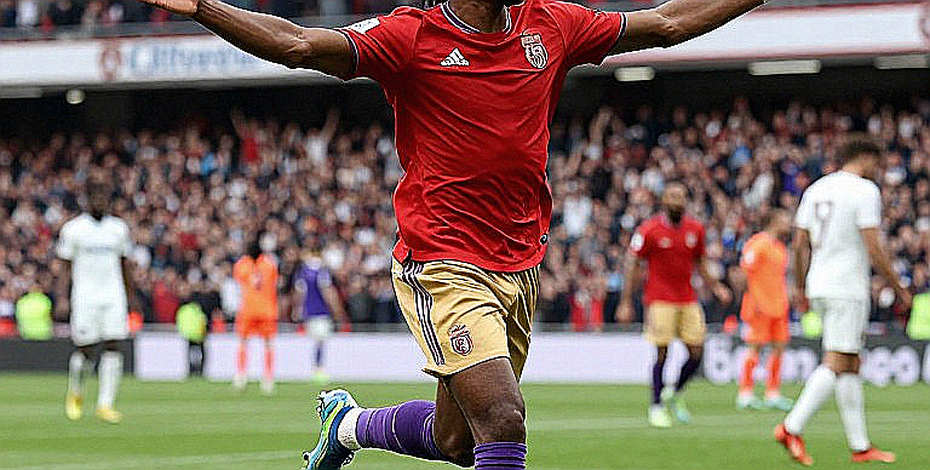
Feyenoord's second half carried the fingerprints of a deliberate adjustment. Their danger concentrated in the wide corridors: Targhalline crossing from the flank, Dest crossing from the flank, and Anis Hadj Moussa repeatedly receiving in one-against-one situations on the right. That is the familiar pattern of a side that has just been suffocated for forty-five minutes: move the ball wide faster, break the opposing back line into individual duels, avoid threaded passes into crowded areas. Most likely Feyenoord pushed their pressing line higher and went more direct after the interval. That is inference, not data — but it matches where the chances came from.
At the other end, PSV's goalkeeper is the reason the hosts kept a point. After the equaliser he made at least three saves: twice from Ferri, once from Hadj Moussa. Just before half-time he had already denied Ferri. When a home side's biggest second-half contributions come from a pair of gloves, the underlying chance creation has gone negative.
Around the 75th minute Feyenoord put the ball in the net a second time. Perisic backheeled inside the box, Geertruida finished from close range, and the assistant's flag went up for offside. The original report endorses the call. Whether this was a rehearsed high-line trap or a marginal judgement cannot be separated from the text — but it does show PSV's back line holding its line discipline during the exact spell when they were under the most pressure.
PSV's point depended on their goalkeeper, and that is a sustainability red flag. A home team that allows clear chances to arrive in sequence through the second half and escapes on reflexes is living off an individual's above-baseline performance rather than off collective structure. Across seasons, I have watched this kind of points haul drift back toward the mean quickly. The one-team-per-half pattern also deserves more scrutiny than it usually gets. It reads as evidence of two evenly matched sides, but that reading ignores another possibility: both pressing structures are state-dependent — tight while fresh, porous once intensity drops. If so, that is a season-long problem, not a one-match problem.
On Anis Hadj Moussa: this is the profile I still call the subject matter of academy archaeology. Unearthed from the sediment, where names have not yet been carved into legend. I do not hunt for established stars. I hunt for the moment they were overlooked. A young wide dribbler who finishes from the corner of the box is the most liquid asset class in the transfer market, and a goal in a top-of-the-table fixture is exactly the data point scouting departments highlight in red. Every transfer is a stratum: the hurried count the money, the archaeologist reads the era. My working hypothesis is that this player's valuation gets repriced within six to twelve months, and I will come back to test that hypothesis rather than shadowing his every match.
One thing I have to say plainly, because I have been wrong in exactly this way before. The raw wire copy I built this piece on contains attributions that do not match public records: the name given as Feyenoord's head coach, and the placement of a Feyenoord academy graduate inside the PSV XI. I have flagged both and downgraded the confidence of the entire tactical reading by one tier. What I have analysed above is the match as it was reported, not a claim about objective fact. This is how I keep myself from building a beautiful conclusion on a rotten foundation.
The final limit also needs stating: the report contains not a single line about substitutions — no timings, no personnel, no shape changes. Any claim about either coach's bench impact would be invention. From that tunnel, I choose not to dig.
The next six to twelve months will answer two questions. Is PSV genuinely goalkeeper-dependent, or was this one night of extraordinary reflexes? And can Feyenoord, four points clear with a forward line that knows how to equalise after the break, convert that cushion into a Champions League place — the item that rewrites the entire revenue table of an Eredivisie club? Empty stands or full, history keeps recording every ball. The recorder just has to know which stratum he is reading.